Certificate of origin (CO): what is it and why is it needed?
A certificate of origin (CO) is a document that certifies the country in which a commodity or good was manufactured. This document is used in international trade to determine the source of the product and contains information such as the product description, value, and country of origin. The certificate of origin is used by customs authorities to determine the eligibility of goods for preferential tariff treatment and verify the authenticity of the goods being imported. Certificates of origin can also be used to enforce policy measures, like trade embargoes, import quotas, anti-dumping measures, or safety measures.
Types of certificates of origin
There is no standardised certificate of origin (CO) form for global trade, since specific requirements vary depending on the type of goods and destination.
Certificates of origin are primarily divided into two types: non-preferential and preferential.
- Non-Preferential CO: Also known as an “ordinary CO”, this indicates that the goods are not eligible for reduced tariffs or tariff-free treatment under trade arrangements between countries. An ordinary CO is required if there is no treaty with the importing country or if a specific product is excluded from tariff relief.
- Preferential CO: This means that there is a free trade agreement or reduced tariffs in place between countries. For instance, exports between EU countries are exempt under the EU free trade agreement and would receive a preferential CO.
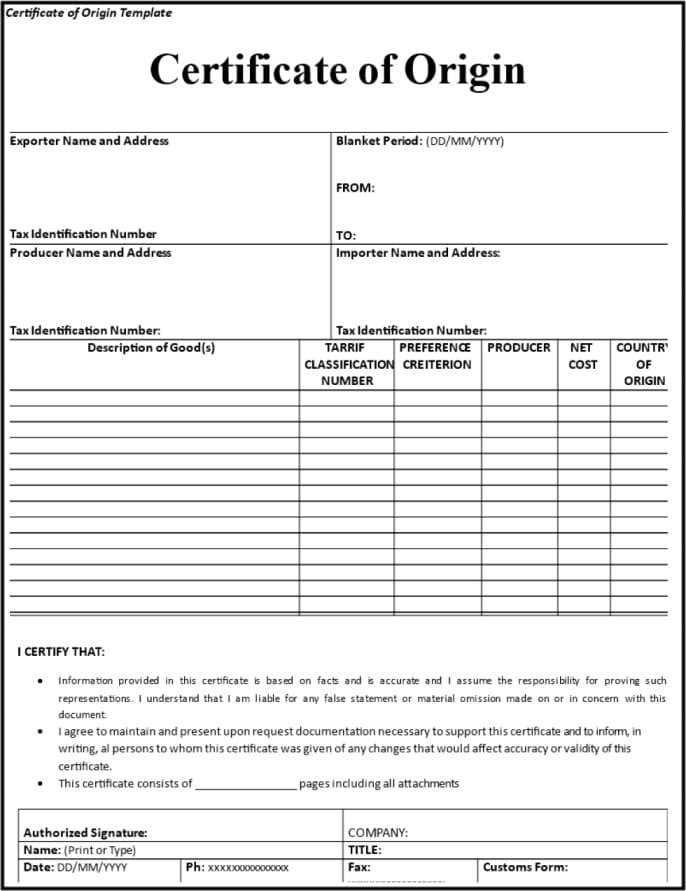
Below is the general structure of a certificate of origin:
What is included on a certificate of origin?
The following information is usually included in COs:
- The name and contact details of the producer of the goods
- The name and contact details of the exporter
- The name and contact details of the importer/receiver
- The country of origin
- A clear goods description, including HS codes, quantity, size, and weight
- A waybill or bill of lading number
- Means of transport and route information
- Commercial invoice number(s) and date(s)
- Additional notes or remarks, if relevant
How to get a certificate of origin
The requirements for obtaining and validating a CO may vary depending on the country, but you will typically have to follow the steps below:
- Register as an exporter.
- Complete an appropriate affidavit.
- Provide a manufacturing or commercial invoice as proof of the origin of your goods.
- Fill out the certificate of origin.
- Submit a notarised affidavit and corresponding invoices, along with your CO, to your chamber of commerce, specifying which documents require stamping.
What is the customs procedure for validating a CO?
Customs officials at the border will examine the certificate of origin to determine the nationality of the goods. The authenticity of the document is verified by checking the:
- CO’s unique reference number
- Signatures on the document
- Validity of the CO (usually up to 12 months after the issue date)
- Official stamps
- Accuracy and consistency, particularly when compared to the commercial invoice and bill of lading


NEED MORE INFORMATION?
FAQ about the certificate of origin and commercial shipping
What determines the country of origin?
Do I need to provide a CO when shipping with Eurosender?
Can anyone produce their own certificate of origin?
Can I use the same CO for another identical shipment?
Can I get an electronic certificate of origin (eCO) instead of the normal paper CO?
- faster trading
- cost savings
- improved security